
René Prou
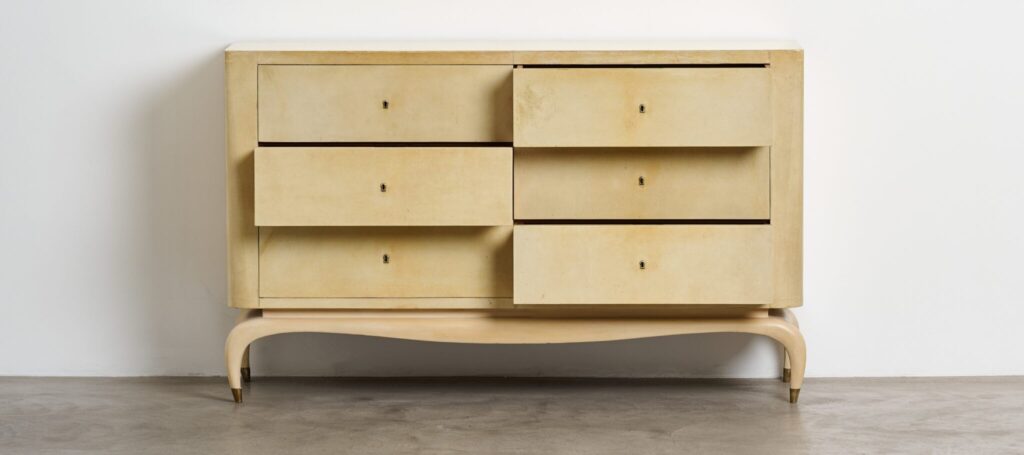
René Prou (Nantes, 1889 – Paris, 1947) was one of the leading figures of French decorative arts in the first half of the twentieth century. After graduating from the École Bernard Palissy in Paris, he settled in the capital and began his career as artistic director for the house of Gouffé, where he developed a reputation for refined craftsmanship and elegant interiors.
His talent quickly earned him prestigious commissions, including the council chamber of the Comptoir d’Escompte de Paris and the residence of the Ambassador of Paraguay. He also designed first-class cabins for several great ocean liners, contributing to the refined aesthetic of luxury maritime travel. During the 1920s, Prou served as both director and professor at the École Nationale Supérieure des Arts Décoratifs, influencing a new generation of designers. From 1928 to 1932, he succeeded Paul Follot as artistic director of Le Bon Marché.
In 1926, he participated in the decoration of the sumptuous Pullman cars of the Orient Express, creating intricate marquetry and lacquered panels that reflected the height of Art Deco sophistication. For the 1937 Universal Exhibition in Paris, he conceived a remarkable pearl-adorned grotto for the couturier Paul Poiret, demonstrating his flair for theatrical elegance.
Over a career spanning four decades, Prou became renowned for his distinctive use of curved forms and ornamentation, as well as for his innovative “zinzin maison” technique—a method of treating metal to give it the flexibility of rattan. The subtlety and finesse of his lines lent his creations a sense of fluidity and understated luxury. By drawing from tradition while embracing innovation, René Prou helped define and shape the language of Art Deco and modern French luxury.